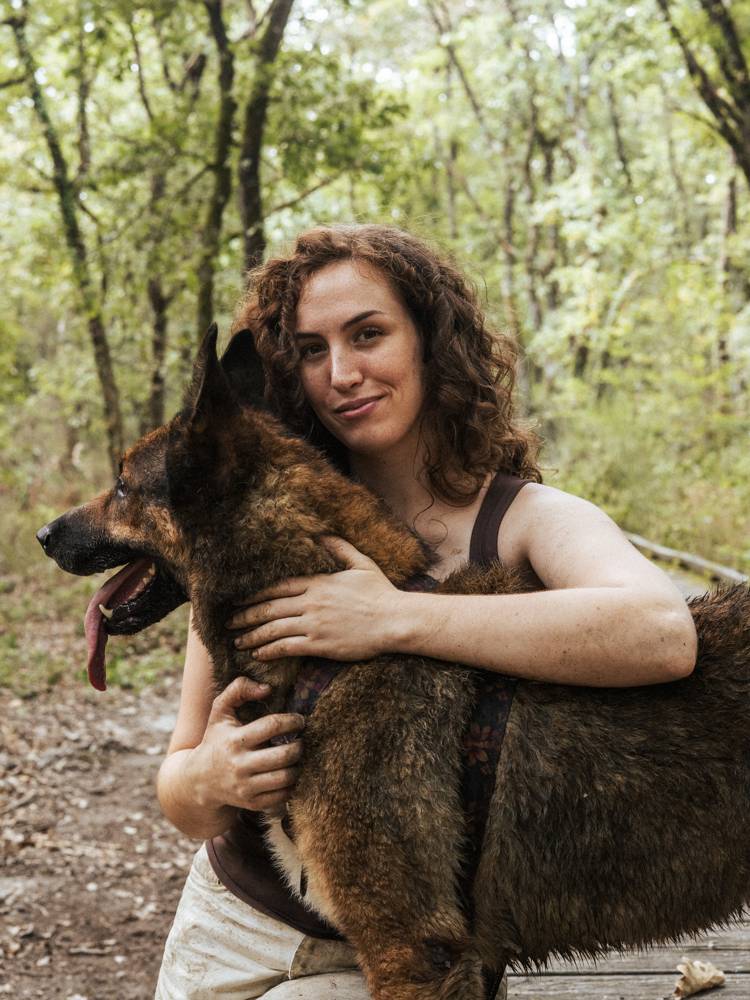
Case 01Reactivity
Hauru
On the surface
He would look at his owner before lunging.
In reality
He had never stopped attacking, and was offloading onto food up to six times a day.
He is dealing with an emotion that overwhelms him: fear, frustration, pain, excitement… That is where my work starts: understanding the cause, so the symptoms can be resolved properly.
So that walks become something you share again, not an ordeal.

The dog you pass in the street is often just the last drop. Build his day, then send something past: in ten seconds you will see what I look for during an assessment.
His dayWhat goes past
What fills it
What empties it
What goes past
Watch his day fill up.
Not only what makes it overflow: pain, lack of sleep, frustration, a complicated relationship with food…
With room below his threshold, he can watch a dog, a bike or a stranger go by without needing to react.
What settles one dog is not necessarily what settles the dog next door. The plan is built for yours.

I am a dog behaviour consultant, and I work mostly with the dogs people find hard to understand: reactive dogs, dogs coming from a difficult life, dogs for whom food has become a problem.
My practice is grounded in ethology and research in animal behaviour. It is what lets me tell a hypothesis apart from a hunch, and recognise when I have got it wrong.
I had already seen several dog trainers before turning to Marie, and none of them had really been able to help me. With Marie, everything changed: she is the first to have understood my dog, not to treat him as a hopeless case, and to give me back some hope.
My dog has a sensitive temperament and is reactive to people and dogs alike. She gave me precise advice, and it gradually settled my daily life.
We have an 8-month-old puppy with serious food problems […] and therefore behavioural ones. […] If you are looking for someone who answers your dog’s real needs, go with your eyes closed.
A reactive dog sometimes has a complicated relationship with food. A second-chance dog can have both. We look at the whole dog.
The dog barks, pulls, freezes, flees, lunges, or even bursts with excitement at a dog, a person, a bike. Underneath the behaviour, there is always a cause.
02Shelters, laboratories, abuse, sensory deprivation, adoption from abroad. The plan starts from where the dog actually is, not from where he should be.
03Overexcitement, refusal, eating too fast, freezing in front of food: same ground, opposite shapes. Common ground, and rarely recognised.
This is not a fallback, it is often the better option. A dog observed at home, with no stranger in the room, shows what he lives with every day. That is even truer of dogs who react to people.
In France, across the French-speaking world and in English. In person: around Toulouse, only as part of joint work with a vet.
What people thought they saw, and what was actually happening. Real cases, told with their humans’ agreement.
On the surface
He would look at his owner before lunging.
In reality
He had never stopped attacking, and was offloading onto food up to six times a day.
On the surface
A vet had put it down to predation.
In reality
A posture he had learned to drive off the dogs he was terrified of. Defence, not hunting.
On the surface
Yet another dog broken by laboratory testing.
In reality
A resilient, resourceful dog who simply needed someone to understand how she works.
On the surface
Their guardian thought Denver was protecting his sister.
In reality
He was reacting to Lisbonne’s tension. A barometer, not a bodyguard.
On the surface
A snappy little dog who went for everything that existed.
In reality
This was not nastiness, it was terror.
Scroll to see all five.
Read the full casesThe same amounts for everyone, however hard the case is assumed to be. You know what you are getting into before you speak to me.
No commitment. You tell me what is going on, I tell you what I make of it, and honestly whether I am the right person.
A detailed questionnaire beforehand, then the analysis, a plan built for your dog and your own online space. Some dogs need nothing more.
A few one-off sessions, or three months of ongoing support after the assessment: six sessions, and you can write to me in between, for the whole period.
The assessment is not included in the three months of ongoing support.
Three months in a group of six, up to five of your cases each. Reactivity and food-related anxiety, where the two meet.
Read about mentoring → Door 02Boarding kennel, day care, clinic, event: animal welfare at the centre of your projects, before you open.
Read about project consulting →Fifteen minutes online, free and with no commitment. You will know what the next step would look like before spending anything.